UK welcomes progress made and remains firmly committed to reversing and halting biodiversity loss
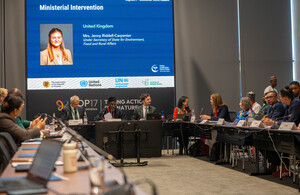
The UK has renewed calls for the global community to step up action to reverse the decline of nature as the UN Biodiversity COP17 concluded.
Delegates at the summit, which included Nature Minister Jenny Riddell-Carpenter and Special Representative for Nature Ruth Davis negotiated a new roadmap to accelerate the urgent action needed to tackle nature loss, including on tackling nature-harmful subsidies and incentives, increasing support for developing countries, strengthening implementation and increased monitoring. Parties also secured agreement on the critical package of decisions needed to maintain international momentum towards 2030.
Nearly $2 billion in new biodiversity funding was announced by countries globally. Parties reached agreement on resource mobilisation, agreeing the need to increase finance from both public and private sources. The UK has successfully unlocked record investment in nature, and a growing number of countries are now looking to the UK’s expertise in balancing economic growth with nature recovery.
The UK announced £28 million of continued funding to help support countries to integrate nature in economic decision-making and attract more nature-positive investment, and a further £10 million of funding for research tackling the causes of biodiversity loss in the Amazon, Congo Basin and Coral Triangle, while supporting climate resilience and reducing poverty.
Funding for these latest commitments come from the UK’s existing international aid budget, demonstrating government’s commitment to protecting the global ecosystems we all reply on.
It was also announced at COP that two further UK companies, Disyn Biotec and Verna Earth Solutions, will contribute to the Cali Fund, a global mechanism through which companies benefiting commercially from nature’s genetic data can contribute to biodiversity conservation. At least half of the Fund’s resources are designated for indigenous peoples and local communities, with the remainder helping developing countries to deliver their national biodiversity commitments.
Nature underpins our economy and food security while supporting our health and wellbeing, and it is positive that progress has been made at COP17.
The real test will be the action and delivery that now follows. This government will continue ramping up efforts to halt and reverse biodiversity loss, both at home and around the world.
Alongside the negotiations last week, the UK announced £1.94 million to support The Wildlife Trusts’ purchase of the Rothbury Estate, helping to secure a nationally important landscape for long-term nature recovery and meet the target to protect and restore 30per cent of the country’s land for nature. On the same day we launched a new 30by30 publication, ‘From Commitment to Conservation’ showing how countries, communities and conservation partners are turning the global 30by30 commitment into practical conservation outcomes.
The UK will continue pressing for stronger action to address the links between climate change and nature loss, while turning global commitments into practical action at home and internationally ahead of COP18 in Ecuador in 2028.
We welcome the UK’s generous support for UNDP’s work to help countries scale up finance for nature, especially focusing on private sector investments and greening subsidies.
As the UK’s assessment shows, the loss of nature weakens human development and risks food security, economic resilience, and national security. This contribution will help our partner countries unlock nature-positive investments at scale, spurring economic growth and jobs that deliver lasting benefits for people and the planet.”
We are grateful to Defra for their continued support and for their leadership in treating nature as a source of economic stability, national security, and resilience, including through the Valuing Nature Portfolio funding. Nowhere is this more true than in Africa where nature underpins so much of our economy.
With their support we are working to reshape how the continent’s financial sector integrates nature into policy and investment decisions. When financial institutions understand their dependence on nature, they can better value it, invest in it, and protect it.